

Victorine Njong
September 16, 2026
Small Residential Assisted Living Benefits: 2026 Guide
Table of Contents
- What Makes Small Residential Assisted Living Different
- Assisted Living vs Nursing Home: Key Differences
- Staff-to-Resident Ratio Benefits in Small Homes
- Residential Care Home Regulations in Texas
- Personalized Care Plans and Daily Living Support
- Social Engagement and Emotional Well-Being
- How to Evaluate a Small Residential Assisted Living Home
- Frequently Asked Questions
Last Updated: September 14, 2026
What Makes Small Residential Assisted Living Different
Small residential assisted living is a care model where a handful of older adults live together in a licensed, home-style setting rather than a large campus, with personal care, meals, and 24-hour supervision on site. The benefits families notice first are intimacy, consistency, and a daily rhythm that looks like family life instead of a hospital shift change. This guide from Providence Assisted Living Solutions covers what that means for your parent, and where small homes fall short.
Most families compare settings on the wrong axis. They count amenities when they should be counting faces: how many caregivers know your mother’s name, her coffee order, and that she gets restless at dusk.
The Home-Like Environment vs. Institutional Care
The difference is architectural before it is clinical. A residential care home typically has a shared kitchen, a living room with personal furniture, and private or semi-private bedrooms along a single hallway. Residents eat at a dining table, not a tray table. They help fold laundry or water plants if they want to, and that ordinary participation matters more than most tours suggest.
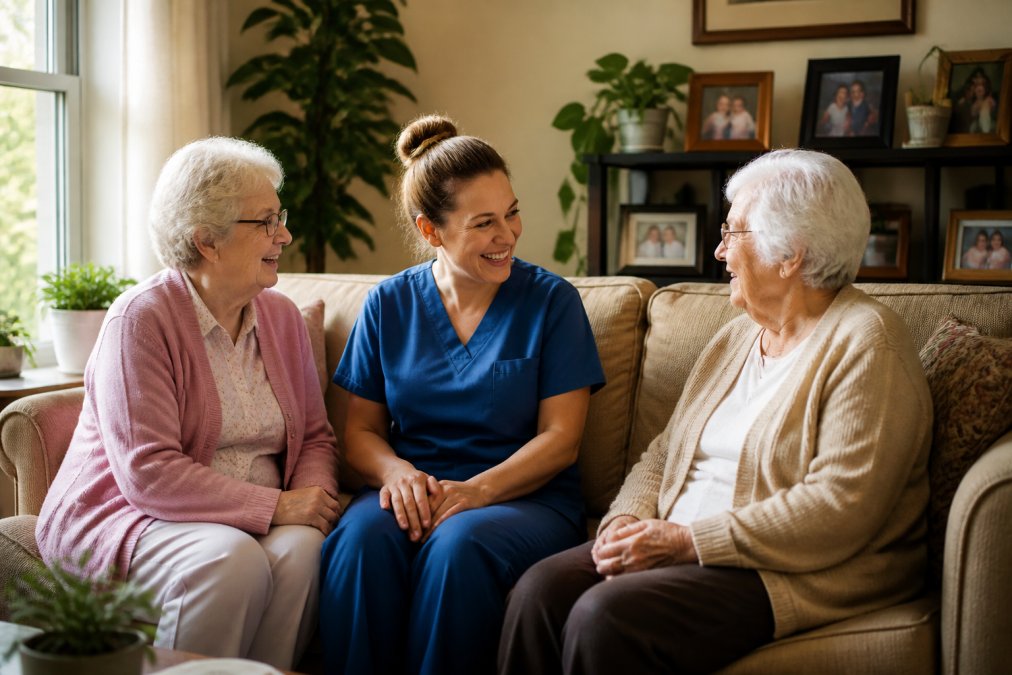
In larger facilities, a resident may pass dozens of staff who never learn their history. In a small home, the same few people show up every day. That continuity is the whole product.
Key Takeaway
The home-like environment is not decoration. Familiar surroundings and consistent faces reduce confusion for residents with cognitive decline, which is why small homes often suit memory care better than a large memory unit.
The home-like environment is not decoration. Familiar surroundings and consistent faces reduce confusion for residents with cognitive decline, which is why small homes often suit memory care better than a large memory unit.
Assisted Living vs Nursing Home: Key Differences
An assisted living community supports Activities of Daily Living (ADLs) such as bathing, dressing, grooming, and mobility, while a nursing home provides skilled nursing and medical care around the clock. The National Institute on Aging guide to long-term care draws the same line: assisted living is for people who need help with daily tasks, and nursing homes are for people who need continuous medical or nursing supervision.
That distinction matters, but it is not the comparison most families are actually making. By the time you are touring, you have usually ruled out a nursing home. The real decision is between a small residential care home and a large assisted living community, settings that differ in ways a brochure will not surface.
Care Levels and Staffing Models
Assisted living generally covers personal care, medication management, meal preparation, housekeeping, and social programming. Nursing homes add skilled nursing, rehabilitation, and often ventilator or wound care. A small residential home sits at the assisted living end, with a licensed operator and trained caregivers on site at all hours.
The staffing model is where small and large diverge most. A large community may employ dozens of caregivers across three shifts, so your parent interacts with a rotating cast. A home capped at 11 residents runs a tighter crew, with the same two or three people handling morning care, meals, and evening routines. Neither model is automatically safer, but the small model makes it far easier for a caregiver to notice your mother ate half her breakfast, the kind of signal that precedes a real problem.
When a Nursing Home Is the Better Choice
Be honest about this one. If your parent needs IV therapy, complex wound care, or round-the-clock skilled nursing, a residential home is not the right setting. The Medicare guidance on nursing home and assisted living care is clear that skilled nursing needs belong in a skilled facility. A good small home will tell you that during the tour rather than after move-in.
The harder call is the middle ground: a resident whose needs are stable today but likely to escalate. Ask any home you tour what happens when a resident crosses from “needs help” into “needs nursing.” A well-run home coordinates the move and stays in touch; a poorly run one waits for a crisis.
Small Residential Home vs. Large Assisted Living Community
| Factor | Small Residential Home | Large Assisted Living Community |
|---|---|---|
| Typical resident count | Under 12 | 50 to 200+ |
| Caregivers your parent sees daily | Usually 2 to 4 | Often 8 to 15 across shifts |
| Dining | Shared table, home-cooked meals | Dining hall, scheduled seatings |
| Private space | Private or semi-private bedroom | Studio to two-bedroom apartment |
| On-site amenities | Living room, kitchen, yard | Gym, salon, theater, multiple dining venues |
| Staff turnover effect | One departure disrupts the whole home | Absorbed across a larger roster |
| Best for | Stable needs, memory care, residents who dislike crowds | Residents who want amenities and a larger social pool |
Key Takeaway
The trade-off is scale versus intimacy. A large community offers more programming and more peers; a small home offers fewer faces and deeper familiarity. Decide which one your parent will actually thrive in before you decide which one looks better on a tour.
The trade-off is scale versus intimacy. A large community offers more programming and more peers; a small home offers fewer faces and deeper familiarity. Decide which one your parent will actually thrive in before you decide which one looks better on a tour.
Staff-to-Resident Ratio Benefits in Small Homes
Staff-to-resident ratio benefits show up in small things: a caregiver who notices a new limp before it becomes a fall, a shower at the resident’s preferred hour, a meal adjusted because someone’s appetite changed. In a home capped at 11 residents, one caregiver can realistically know everyone’s baseline.
That baseline knowledge is the real safety net. Fall prevention, hydration, and medication management all depend on someone noticing a deviation from normal, and normal is only visible when the same people are watching every day.
Pro Tip
Ask a home how they cover overnight hours and what happens when a caregiver calls out sick. The answer tells you whether “24-hour supervision” means a trained, awake staff member or someone sleeping down the hall.
Ask a home how they cover overnight hours and what happens when a caregiver calls out sick. The answer tells you whether “24-hour supervision” means a trained, awake staff member or someone sleeping down the hall.
Residential Care Home Regulations in Texas
Residential care home regulations in Texas are administered by the Texas Health and Human Services assisted living licensing program, which classifies these homes by license type based on resident needs and capacity. Small homes operate under a specific license category, and that classification determines how much care they are permitted to provide. Confirm the license type before you sign anything, because it caps what the home can legally take on.
Licensing, Inspections, and the Ombudsman Program
Licensed homes are subject to periodic inspections, and survey results are public. The Texas Long-Term Care Ombudsman Program exists to advocate for residents and investigate complaints, and families can contact it directly. Ask for the home’s most recent inspection report and read the deficiencies, not just the star rating.
Regulations vary by state, so verify current requirements and any recent changes with the licensing authority rather than relying on a guide. Providence Assisted Living Solutions holds a Type-B license and has been featured as a Top-Rated Community in Fulshear by Assisted Living Magazine.
Personalized Care Plans and Daily Living Support
An individualized care plan is a written document recording a resident’s needs, preferences, and routines, and assigning who handles each one. It should cover bathing and grooming assistance, mobility support, medication management, and dietary requirements, and be reviewed as needs change rather than filed away at move-in.
The question families ask most is what happens when needs escalate. A well-run home updates the care plan and adjusts staffing or services in place for moderate changes. When needs exceed what the license permits, the home should coordinate the next step rather than leave you scrambling.
Watch Out
Never accept a verbal care plan. If the home cannot show you a written plan with review dates and named responsibilities, you have no way to hold anyone accountable when something slips.
Never accept a verbal care plan. If the home cannot show you a written plan with review dates and named responsibilities, you have no way to hold anyone accountable when something slips.
Social Engagement and Emotional Well-Being
Social isolation is one of the quieter risks of aging, and large facilities can inadvertently create it when residents stay in their rooms. Shared meals, group activities, and a living room people actually use are the countermeasures. In a small home, residents are naturally in each other’s orbit, and staff can nudge someone into the group instead of noting it in a chart.
But the emotional story most guides skip starts before move-in. The transition itself, leaving a house your parent may have lived in for 30 or 40 years, is often harder than the day-to-day care that follows. Understanding that psychology separates a smooth move from a six-month adjustment crisis.
The Transition Psychology Nobody Warns You About
Most families plan the logistics: downsizing, paperwork, movers. Very few plan for the grief. A parent who chose the move willingly can still mourn a kitchen, a garden, a neighbor, a version of themselves who hosted holidays. That grief is normal, and it does not mean the decision was wrong.
Practitioners describe a three-stage arc. The first weeks bring relief and exhaustion. The next month or two often bring a dip, irritability, withdrawal, sometimes refusing meals. Then, usually between the second and fourth month, a resident settles: learning the routine, claiming a chair, forming a first friendship. Knowing the dip is coming helps families ride it out instead of moving their parent again, which resets the clock.
Why Small Homes Often Ease the Transition
A large community can overwhelm a new resident who is already disoriented. Long hallways, unfamiliar faces, and a dining hall full of strangers amplify the sense of lost footing. A small home compresses the world to a size a new resident can hold in their head: one hallway, one table, a handful of names.
That compression is a genuine advantage for residents with early cognitive decline, who often do better in a small, predictable environment. It also means staff spot withdrawal early: in a home with eight residents, a caregiver notices on day three that someone is eating alone. In a community of 150, that resident can disappear into the crowd for weeks.
What Families Can Do to Help
- Visit on a predictable schedule. Consistency gives a new resident something to anchor to. A standing Sunday lunch does more than a surprise drop-in.
- Bring the familiar. A favorite quilt, a photo album, a chair from home. Small homes usually welcome this; ask first.
- Resist the urge to over-schedule. New residents need downtime. Filling every hour can backfire.
- Listen for the dip, don’t react to it. A rough week six is not a verdict on the home. Give it time.
- Ask staff what they are seeing. Caregivers often notice mood shifts before families do, and a good home will tell you rather than wait for you to ask.
Pro Tip
Ask the home how they handle a resident who is struggling to adjust. The answer tells you whether they have a real onboarding process or whether they simply hope new residents figure it out on their own.
Ask the home how they handle a resident who is struggling to adjust. The answer tells you whether they have a real onboarding process or whether they simply hope new residents figure it out on their own.
Community engagement in a residential setting looks ordinary: card games, gardening, church services, family visits, a birthday cake at the kitchen table. That ordinariness is the point. Ask what a typical Tuesday afternoon looks like, and listen for whether the answer is specific.
How to Evaluate a Small Residential Assisted Living Home
Evaluate with a checklist, not a feeling. Tour twice, once scheduled and once unannounced, and watch how staff speak to residents when they think no one is grading them.
- Verify the current license type and capacity with the state licensing authority
- Read the most recent inspection report and ask about any deficiencies
- Confirm the staff-to-resident ratio on day, evening, and overnight shifts
- Request a sample written care plan and ask how often it is reviewed
- Ask what happens if your parent’s needs increase beyond the license
- Observe a meal and check whether residents eat together
- Ask how families are updated, especially if you live out of state
- Meet the person who will actually be there at 2 a.m.
Two angles most families never probe: staff retention and technology. Ask how long current caregivers have worked there, because turnover breaks the continuity that makes small homes work. Then ask how the home tracks medications and shares health updates with families, since a small operator without a reliable system creates exactly the gaps you are trying to avoid.
Choosing care for a parent means accepting that no setting is perfect and that the trade-offs matter more than the brochure. Small residential homes trade scale for intimacy, and that trade favors families who want their loved one known by name. Providence Assisted Living Solutions was built around that idea: a home with just 8 rooms and a maximum of 11 residents, higher staff-to-resident ratios than corporate facilities, personalized care plans, 24/7 care and supervision, and chef-prepared home-cooked meals. If you are weighing options in the Fulshear, Katy, or Richmond area, book an appointment to see the home in person and meet the people who would be caring for your parent.
Frequently Asked Questions
How does a small residential assisted living facility differ from a large nursing home?
Small residential assisted living homes typically serve fewer than 12 residents in a house-like setting, while nursing homes are larger medical facilities. The smaller scale allows for higher staff-to-resident ratios, more personalized attention, and a home-like environment. Nursing homes provide skilled nursing care for complex medical needs. Small homes focus on daily living support, medication management, and social engagement in a familiar, comfortable setting.
What are the primary benefits of a high staff-to-resident ratio in senior care?
A high staff-to-resident ratio means caregivers can respond faster to individual needs, provide more one-on-one assistance with activities of daily living, and notice subtle health changes sooner. It also reduces staff burnout, which supports care continuity. In small residential assisted living homes, this ratio allows for personalized care plans, meaningful social interaction, and a calmer environment that benefits residents with cognitive decline or mobility challenges.
Is residential assisted living covered by Medicaid in Texas?
Texas Medicaid offers some coverage for assisted living through HCBS Medicaid waivers, but eligibility and services vary. These waivers are designed to help seniors receive care in home-like settings rather than institutions. Because waiver availability and program rules can change, families should contact the Texas Health and Human Services Commission directly or consult a Medicaid planning professional to understand current options for residential care.
How do chef-prepared meals and social activities improve quality of life for seniors?
Chef-prepared meals provide balanced nutrition, which supports physical health and energy levels, while the social aspect of shared dining reduces isolation. Regular activities like games, music, and group exercise keep residents engaged and mentally stimulated. In small residential assisted living homes, these routines are tailored to resident preferences, creating a sense of purpose and community that large facilities often struggle to replicate.
Recent Post

Big News! Providence Assisted Living Solutions
State Long-Term Care Ombudsman Program
May 12, 2026

Our Friendly Staff
May 27, 2026