


Victorine Njong
October 05, 2026
Memory Care Facility for Seniors: A Selection Guide
Table of Contents
- Understanding Memory Care Facilities and What Sets Them Apart
- What to Look for in a Memory Care Facility
- Questions to Ask Memory Care Facilities During Your Visit
- Memory Care Cost Per Month and Payment Options
- Memory Care vs Assisted Living: Key Differences
- How to Evaluate and Compare Memory Care Facilities
- Matching Care Levels to Dementia Progression
- Frequently Asked Questions
Last Updated: October 5, 2026
Understanding Memory Care Facilities and What Sets Them Apart
A memory care facility is a specialized residential community designed specifically for older adults living with dementia, Alzheimer’s disease, or other cognitive decline. Unlike general assisted living, memory care communities provide structured environments, trained staff, and therapeutic activities tailored to the unique challenges of memory loss and behavioral changes.
The difference matters enormously. Standard assisted living focuses on help with daily activities. Memory care goes deeper, it addresses wandering prevention, sundowning, confusion, and the emotional needs of residents who may not recognize family members or remember their own history. The environment itself becomes part of the treatment.
At Providence Assisted Living Solutions, we understand that families don’t just need a place for their loved one to live. They need a community where staff understand the disease, and where the setting itself reduces anxiety rather than creating it.
Memory care communities typically offer 24-hour supervision, secured environments, cognitive activities designed for declining abilities, and staff trained in dementia-specific communication and care techniques. They’re neither nursing homes nor independent senior living, they occupy a middle ground that works best for people in moderate to advanced stages of cognitive decline who still benefit from a homelike setting.

What to Look for in a Memory Care Facility
When evaluating options, focus on three core areas: staff expertise, environmental safety, and personalized care planning. These factors directly affect your loved one’s quality of life and your own peace of mind.
Staff Training and Dementia Expertise
The quality of care hinges on staff who understand dementia as a disease, not a behavioral problem. Look for facilities where caregivers have completed dementia-specific training, not just general certification in assisted living.
Ask about training content: Do staff learn how to respond to wandering? Can they recognize pain in someone who can’t communicate it verbally? Do they understand how to redirect agitation without medication?
Staff-to-resident ratios matter more in memory care than anywhere else. Larger facilities often operate with thinner staffing. Smaller, intimate communities can maintain higher ratios, meaning more one-on-one attention and better response times when something goes wrong. This is where a family-style setting creates real advantages.
Safety Features and Secure Environment Design
Memory care facilities must prevent wandering while avoiding the institutional feel of a locked unit. The best ones use design cleverly, secured perimeters that don’t look like cages, gardens that feel like freedom but are safely enclosed, visual cues that help residents navigate without confusion.
Check for basic safety infrastructure: How are exits monitored? Are there cameras? What’s the protocol if a resident wanders? How does the facility handle aggressive behavior or refusal of care? These aren’t theoretical questions, they’re daily realities in memory care.
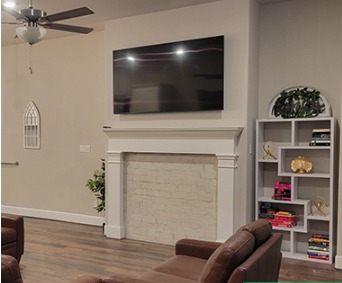
The physical environment should feel residential. Bright, natural lighting reduces sundowning. Familiar furnishings and decor help orient residents. Noise levels should be calm.
Personalized Care Plans and Activities
Generic activities, bingo, movie time, don’t work for people with advanced dementia. Look for facilities that offer individualized programming based on each resident’s history, abilities, and preferences.
Does the facility offer cognitive therapy or reminiscence activities? Do they engage residents in meaningful tasks, not just time-filling activities? Can they adapt activities as cognitive abilities decline further?
Ask how the facility handles changing needs. Your parent’s dementia will progress. Will they stay in the same community as care needs increase, or will they need to move? Facilities that offer progressive levels of care within the same community reduce trauma and disruption.
Questions to Ask Memory Care Facilities During Your Visit
Prepare a list before you tour. Take notes. Pay attention to how staff answer, do they seem genuinely knowledgeable, or are they reciting scripts?
Staffing and Coverage Questions
Ask directly: What’s your staff-to-resident ratio, and does it stay consistent 24/7? Who’s on duty at night? Are nurses on-site, or only during business hours? What’s the turnover rate? High turnover means your parent builds relationships with people who then leave.
How are emergencies handled? If your parent falls at 2 a.m., what happens? Is there immediate medical response on-site, or do they call an ambulance? What medical equipment is available? Can they handle a resident who becomes combative or refuses care?
What training do staff receive specifically for dementia? How often? Is it ongoing?
Care Quality and Family Communication
How often will you hear from the facility? Daily? Weekly? What happens if something changes, medication, behavior, health status? Will someone call you, or do you have to ask?
Can you visit anytime, or are there restrictions? Can family be involved in care decisions and activities?
Ask about medication management. Who oversees prescriptions? How do they monitor for side effects? Memory care residents often take multiple medications, oversight matters.
Memory Care Cost Per Month and Payment Options
Memory care costs vary widely depending on location, facility size, and level of care. Pricing depends on several factors: what services are included in the base rate, and whether specialized care costs extra.
Rather than guessing at figures, ask each facility for a detailed cost breakdown. Request clarity on what’s included, meals, activities, laundry, transportation, and what costs extra. Some facilities bundle everything; others charge separately for incontinence supplies, specialized activities, or additional supervision.
Ask about payment options. Do they accept Medicaid? Medicare? Private pay? Long-term care insurance? Many families combine multiple payment sources. Understanding your options helps you plan realistically.
Providence Assisted Living Solutions can discuss your specific situation and help clarify what’s included. Transparent pricing is essential, you shouldn’t discover hidden charges after your parent moves in.
Memory Care vs Assisted Living: Key Differences
The distinction is critical because it affects safety, cost, and whether the facility can meet your parent’s actual needs.
Assisted living focuses on help with activities of daily living, bathing, dressing, meals, medication reminders. Staff are trained in general caregiving. Residents are typically independent enough to recognize staff, follow instructions, and communicate their needs.
Memory care assumes cognitive decline. Residents may not remember they took their medication an hour ago. They may not recognize their own room or understand why they’re being bathed. Staff must be trained to handle confusion, repetitive questions, wandering, and behavioral changes. The environment is specifically designed to compensate for memory loss.
A resident in early-stage dementia might do fine in assisted living with good oversight. Someone in moderate to advanced stages needs the structure, training, and specialized environment of memory care.
Some facilities offer both assisted living and memory care. This matters if your parent’s condition will progress, they can move within the same community rather than relocating entirely.
How to Evaluate and Compare Memory Care Facilities
Create a comparison checklist. Visit multiple facilities. Trust your instincts about how your parent would feel there.
Licensing and Regulatory Compliance
Memory care facilities must be licensed. Check your state’s long-term care licensing board, they maintain public records of inspections, violations, and complaints. A facility with no violations is rare; look for how they respond to violations.
Ask the facility directly: What’s your current license status? Have there been any violations in the past three years? What were they, and how were they resolved?
Ask about their relationship with your state’s Long-Term Care Ombudsman Program. Ombudsmen investigate complaints and advocate for residents.
Facility Tour Checklist and What to Observe
During your visit, look beyond what staff show you. Walk the halls. Check common areas. Notice whether residents look engaged or sedated. Are activities actually happening, or do residents sit passively watching TV?
Observe staff interactions. Do they speak to residents respectfully? Do they use touch gently? Do they seem rushed or calm? Spend time in dining areas, activity spaces, and outdoor areas if available.
Check cleanliness. Does it smell institutional or residential? Are there odors suggesting incontinence management issues? Is the facility well-maintained?
Talk to current residents’ families if possible. Ask them what surprised them, what they wish they’d known, whether they’d choose the same facility again.
| Evaluation Factor | What to Look For | Red Flag |
|---|---|---|
| Staff training | Dementia-specific certification, ongoing education | Generic assisted living training only |
| Staff-to-resident ratio | Higher ratios, consistent 24/7 | Thin staffing, high turnover |
| Environment | Residential feel, secure but not institutional | Locked doors, institutional appearance, noise |
| Activities | Individualized, cognitive engagement | Generic bingo and movies only |
| Family communication | Regular updates, open visitation | Limited contact, discouraging visits |
| Licensing | Current license, minimal violations | Unresolved violations, complaints |
| Transparency | Clear pricing, honest answers | Vague costs, defensive responses |
Matching Care Levels to Dementia Progression
Dementia doesn’t progress in a straight line, but it generally moves through stages, and the right facility changes as needs change.
Early-stage dementia: Your parent still recognizes people, remembers recent events, and can communicate needs. They may benefit from assisted living with dementia training, or they might stay at home with part-time support. Memory care isn’t necessary yet.
Middle-stage dementia: Memory loss becomes obvious. Your parent may wander, repeat questions, struggle with basic tasks. They need supervision during activities of daily living. This is when memory care becomes essential. Your parent needs a structured environment, trained staff, and activities designed for their cognitive level.
Late-stage dementia: Your parent may not recognize family, may not speak, may need assistance with all physical care. They may require hospice care. Some memory care facilities handle this; others don’t. Confirm that the facility can care for residents through late stages, or understand when transition to nursing care becomes necessary.
They adjust care plans as needs change without requiring relocation. This continuity matters enormously, moving someone with advanced dementia is traumatic and destabilizing.
Choosing a memory care facility for your parent is one of the hardest decisions you’ll make as an adult child. It requires balancing your parent’s safety and quality of life with your own capacity to provide care. The right facility, one with trained staff, a homelike environment, and genuine commitment to personalized care, can offer a continuation of dignity and connection.
At Providence Assisted Living Solutions, we built our community around this principle. Our small, intimate setting, high staff-to-resident ratio, and focus on personalized care mean your loved one is treated as family, not a resident number. We understand dementia, and we understand what families need: peace of mind that their parent is safe, engaged, and cared for with genuine compassion.
Area Agency on Aging resources can help you navigate local options and understand payment assistance. The Alzheimer’s Association guide to facility selection provides additional evaluation frameworks. Your state’s long-term care licensing board maintains public inspection records for every licensed facility.
Ready to explore whether Providence Assisted Living Solutions is right for your family? Book an appointment to tour our community and ask your questions directly. We’re here to help you make the best decision for your parent.
Frequently Asked Questions
What services are included in a memory care facility?
Memory care facilities provide 24-hour supervision, assistance with daily living activities (bathing, dressing, medication management), nutritious meals, and cognitive activities designed for residents with dementia. Many also offer social engagement programs, housekeeping, laundry, and family support resources. The specific services vary by facility, so ask about what’s included in the care plan during your tour.
How is memory care different from assisted living?
Memory care is specialized for individuals with Alzheimer’s disease and dementia, featuring trained staff, secure environments to prevent wandering, and activities tailored to cognitive abilities. Assisted living serves older adults who need help with daily tasks but do not have significant cognitive impairment. Memory care facilities typically have higher staff-to-resident ratios, more supervision, and specialized dementia training.
At what point should someone with dementia move to a memory care facility?
The right time depends on individual needs and family circumstances. Consider a move when your loved one requires 24-hour supervision, poses a safety risk to themselves, experiences frequent wandering, or when their care needs exceed what family or in-home care can provide. A consultation with their healthcare provider and a social worker can help guide this decision based on their specific stage of dementia and care requirements.
What should families look for when touring a memory care facility?
Observe the cleanliness and safety features, interact with staff and residents to gauge the atmosphere, ask about staff training in dementia care, review the facility’s licensing status, and inquire about daily activities and personalized care plans. Request a sample daily schedule, ask how they handle behavioral changes. Trust your instinct about whether the environment feels warm and home-like rather than institutional.
Recent Post

Big News! Providence Assisted Living Solutions
State Long-Term Care Ombudsman Program
May 12, 2026


Our Friendly Staff
May 27, 2026